John Buchan, Lord Tweedsmuir, Governor General of Canada and the author of classic novels such as The Thirty Nine Steps and Greenmantle, said that “Every Scotsman with a feeling for the past in his blood should be able at least to find his way in that historical shorthand which is the language of heraldry.”
Heraldry is a universal language which means that anyone who is familiar with heraldry can look at a Scottish Coat of Arms and glean something about the holder
As Scotland has one of the richest armorial traditions in the modern world Buchan’s statement rings as true now as it did eighty years ago.
Its most common modern manifestation of heraldry is in the design, display, description and recording of coats of arms and heraldic badges. In Scotland it is all around us, on buildings, letterheads, school blazers, bank notes, company insignia and the crests of civic authorities, academic institutions and football clubs. The use of heraldry is not restricted to corporate bodies, individuals are also entitled to use Arms and anyone domiciled in Scotland or of Scottish ancestry and domiciled in most parts of the Commonwealth can apply to the Lord Lyon King of Arms for a grant of Arms.
Arms are generally not granted to non-British citizens though the ownership of land in Scotland brings an “alien” within the jurisdiction of the Lyon Court.
An alternative way of bringing oneself within the jurisdiction of the Court is through the ownership of a Scottish feudal dignity, currently in the form of a feudal barony, lordship, earldom or marquisate.
Prior to feudal abolition in 2004, a barony was a landed estate. The dignity of baron was preserved in the Abolition of Feudal Tenure etc. (Scotland) Act 2000 and can now survive independently of the land with which it was originally associated. The acquisition of a feudal dignity gives the holder the legal right to use the title associated with the lands referred to in the Crown Charter, and as well as entitling the holder to petition for Arms, gives many Scottish ex-pats and those of Scottish descent a link with their roots.
The grant of Arms is at the discretion of the Lord Lyon who is the monarch’s representative in all heraldic matters in Scotland. The holder of a Scottish barony can petition the Lord Lyon for a grant of Arms with additaments as long as he or she is, in the eyes of Lord Lyon, a virtuous and deserving person. While there may be some debate about what makes a petitioner virtuous and deserving, for the moment registration of the barony in the Scottish Barony Register is sufficient proof of the existence and ownership of the feudal dignity.
Heraldry is the system by which coat of arms and other armorial bearings are devised, described and regulated.
Petitions can be submitted by the petitioner in person or by a solicitor acting on his or her behalf. Issues do arise and there is therefore some merit in seeking a solicitor’s assistance with the preparation and submission of the petition. Petitions should also include personal information relating to the petitioner, which requires to be backed up with documentary evidence known as Proofs. Petitions are considered on a chronological basis and the current turnaround time from the submission of the petition to the issue of the Letters Patent is about two years. Petitioners can also submit suggestions for the devisal and the Lord Lyon will attempt to accommodate these within the rules and traditions of Scottish heraldry.
In 2014 Lyon Morrow issued a Note in relation to a petition submitted by the holder of the lordship of the Garioch. The Note addressed the issue of whether ownership of a higher dignity, and in this case a lordship, was sufficient to bring the petitioner within the jurisdiction of the Lord Lyon for the granting to him of Arms and a copy can be read on the Lyon Court website, www.lyon-court.com.
The conclusion reached by Lyon was that the petitioner’s ownership was sufficient to found jurisdiction and the terms of the Note were to provide the template for petitions by the holders of lordships and the other higher dignities of earldom and marquisate.
Despite Lyon describing his decision as one fit for the Twenty first century there has been a further change of policy by the Lyon Court and currently letters Patents do not specifically refer to the name of the petitioner's barony.
There are still issues surrounding petitions founded on feudal earldoms where this is an existing territorial earldom of the same name. It is worth taking advice before acquiring an earldom and marquisate if the intention is to petition for Arms. In such situations petitions are looked at on a case by case basis.
Petitions are generally in the following style:
Court of the Lord Lyon
UNTO THE RIGHT HONOURABLE THE LORD LYON KING OF ARMS
The Petition of Alexander MacDonald, Baron of Gleneagles, 3780 Maple Leaf Way, Ontario, Canada.
HUMBLY SHEWETH
- THAT the Petitioner was born on 14 April 1976 at Auchterarder, Scotland, son of James MacDonald nee Campbell.
- THAT the Petitioner married on 14 October 2010 at Ontario, Canada, Catherine Warren, daughter of Charles and Elizabeth Warren.
- THAT by Assignation date 26 November 2013, registered in Volume 3, Folios 104-106 of the Scottish Barony Register on 1 December 2013, he, the Petitioner, hold the Barony of Gleneagles in the County of Perth being of the genus of barony which ownership brings the petitioner within the jurisdiction of the Lord Lyon, King of Arms.
- THAT he, the Petitioner is desirous that there might be granted unto him and his descendants such Ensigns Armorial as might be found suitable and according to the Laws of Arms, together with all the additaments appropriate to the Dignity of Baron in the Baronage of Scotland.
MAY IT THEREFORE please Your Lordship to Authorise the Lyon Clerk to prepare Letters Patent granting unto the Petitioner and his descendants such Ensigns Armorial as Your Lordship may find suitable and according to the Laws of Arms, together with all additaments appropriate to the Dignity of Baron in the Baronage of Scotland.
AND your Petitioner will ever pray,
Signature ….
Date ….
Court of the Lord Lyon
Petition of ALEXANDER MACDONALD, Baron of Gleneagles
SCHEDULE OF PROOFS
TO PROVE:
- Certified copy of Birth Certificate of Alexander MacDonald, certified copy dated 5 May 2014.
- Extract record of marriage of Alexander MacDonald and Catherine Warren dated 6 May 2014.
- Extract record of birth of Catherine Warren dated 1 May 2014.
- Certified copy Degree Certificate, University of Ontario, dated 3 June 1998.
- Certified copy Diploma, Harvard University, dated 5 January 1992, and letter of certification from Harvard University, dated 2 May 2014.
- Certified Copy Assignation by Joseph Lang in favour of Alexander MacDonald registered in the Scottish Barony Register in 1Decemeber 2013.
- Family history showing patrilineal descent.
- Suggest designs for Arms.
Signature ….
Date ….
As referred to previously Lyon Morrow has in a letter indicated that after 1 March 2018 he will no longer include words of recognition in Letter Patent though he will continue to accept ownership of a dignity which has been registered in the Scottish Barony Register as the basis for jurisdiction.
Once the Petition has been considered and approved the Lord Lyon prepares the blazon, which is the written description of the Arms, and issues a draft warrant authorising the preparation of the Letters Patent. The draft warrant is approved by the petitioner or his agent and at this stage the petitioner is invited to suggest additional decoration details of which can be found on the Lyon Court website, www.lyoncourt.com. The Letters Patent are then sealed and signed by the Lord Lyon and recorded in the Register.
Description of the Arms
Arms, are also referred to as a coat of arms, from the central element of the full heraldic achievement which consists of a shield crest and motto and where appropriate supporters. The only additament now granted to the holders of feudal dignities is a steel helm or helmet with three grilles garnished in gold or a steel tilting helm garnished in gold.
Arms are a form of intellectual property and the Lyon Court is in effect a heraldic patent office. The fee paid by the petitioner covers not only the cost of preparing the Letters Patent but also the permanent legal protection afforded by the recording of the Arms in the Register. Again details of costs can be found on the Lyon Court website.
Applications for Arms are made by petition to the Lord Lyon stating the petitioner’s name and craving the grant of Arms.
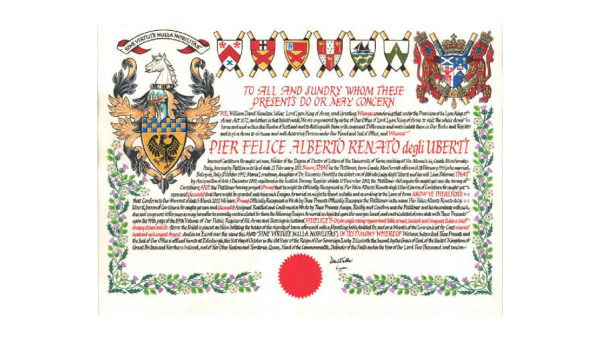

The Letters Patent are reproduced with the kind permission of Dr Pier Felice degli Uberti.